

A master bathroom remodel cost in Minneapolis typically ranges between $28,000 and $75,000, depending on the size of the space, the finish level, and whether any plumbing or electrical work needs to be relocated. Mid-range primary bathroom renovations land closer to $40,000 to $60,000, while luxury primary suite transformations with custom tile showers, freestanding soaking tubs, and radiant heated floors can reach $95,000 to $150,000 or beyond. If your project is more of a cosmetic refresh with a new vanity, updated fixtures, and fresh flooring, you could come in between $15,000 and $28,000.
These are real numbers from the Minneapolis market, not national averages copy-pasted from a generic cost calculator. Minneapolis has its own labor rates, permit requirements, and construction realities that shape what you will actually spend.
Why Minneapolis Homeowners Are Remodeling Their Master Bathrooms Right Now
If you have spent any amount of time in a 1970s or 1980s primary bath with a pink tub surround, a tiny vanity, and a single overhead light, you already know the answer. Minneapolis has an aging housing stock, and a huge portion of homes in neighborhoods like Kenwood, Linden Hills, Longfellow, and Northeast were built before modern bathroom design became what it is today.
Beyond aesthetics, there are practical reasons homeowners in the Minneapolis are pulling the trigger on remodels. The local real estate market remains competitive, and buyers expect primary bathrooms to feel like a retreat, not an afterthought. Dual sink vanities, walk-in tile showers with frameless glass enclosures, and heated floors are no longer optional extras in the eyes of most buyers. They are expected features in homes priced above $500,000.
There is also the comfort factor. Minneapolis winters are genuinely brutal. Stepping onto a heated tile floor on a January morning when the wind chill is 25 below zero is not a luxury, it is a quality of life decision. Radiant floor heating, well-insulated walls, and a properly vented exhaust fan are things that matter year-round in Minnesota’s climate.
Master Bathroom Remodel Cost in Minneapolis by Project Tier
Before diving into individual line items, it helps to understand how the industry thinks about bathroom remodel budgets. Most local contractors in the Twin Cities segment projects into three broad tiers.
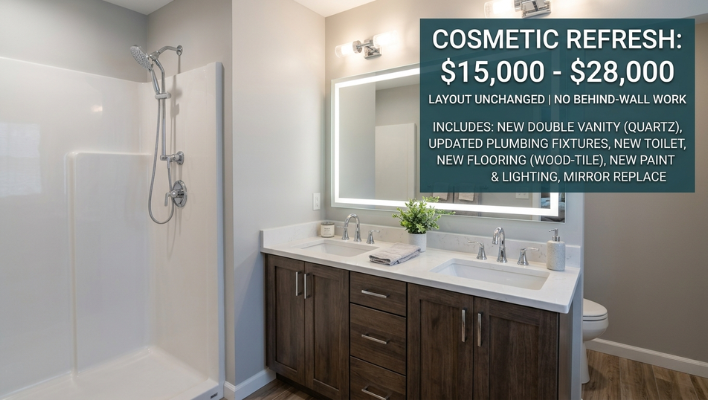
Cosmetic Refresh: $15,000 to $28,000
This tier covers projects where the layout stays exactly the same and no plumbing or electrical lines are moved. You are essentially updating the surfaces and fixtures without touching anything behind the walls. A typical cosmetic refresh might include a new double vanity with quartz countertops, updated plumbing fixtures, a new toilet, new flooring tile, a fresh coat of paint, updated lighting, and mirror replacement. The shower or tub surround might get a prefabricated acrylic replacement or a tile refresh without a full gut.
This is the right budget if your existing bathroom is in sound structural condition and you mainly want it to look and feel more current.
Mid-Range Full Remodel: $28,000 to $60,000
This is where the majority of Minneapolis master bathroom projects land, according to local remodeling contractors. At this level, you are gutting the space down to the studs, installing new waterproofing, replacing all fixtures, doing a full custom tile shower, upgrading the vanity to something built-in and custom or semi-custom, adding radiant floor heating, and possibly reconfiguring the layout slightly.
The 2025 Remodeling Cost vs. Value Report places mid-range to upscale master bathroom remodels in Minneapolis between $43,965 and $84,166 when performed by a professional remodeler, which aligns closely with what Twin Cities design-build firms report from their own completed projects.
Luxury Primary Suite Renovation: $75,000 to $150,000+
High-end projects in neighborhoods like Kenwood, Lowry Hill, or the Chain of Lakes area routinely exceed $75,000 when clients want the full experience. This tier typically involves structural changes such as expanding the bathroom footprint, adding a freestanding soaking tub separate from a custom walk-in shower, installing steam shower systems, incorporating custom cabinetry, using natural stone like marble or quartzite on all surfaces, and integrating smart home features like digital shower controls and programmable heated floors.
Custom primary suites built as part of an owner’s suite expansion can push past $115,000, particularly when the project includes moving load-bearing walls or adding square footage.
What Drives the Cost of a Master Bathroom Remodel in Minneapolis
Understanding where your money goes is half the battle when setting a realistic budget. Here are the major cost drivers specific to the Minneapolis market.
Labor Rates in the Twin Cities
Labor is the single largest cost category in any bathroom remodel, typically representing 40 to 50 percent of the total project budget. Plumbers in Minnesota charge between $85 and $175 per hour in 2026, and those rates have increased roughly 8 to 10 percent from the prior year. General contractors and remodeling project managers typically charge $75 to $150 per hour for their time, or they price labor as a percentage of the overall project.
Minnesota sits approximately 6 percent above the national average in construction costs, driven by strong union trade labor rates, a compressed outdoor construction season that runs roughly from April through November, and robust demand in the Twin Cities metro. If you are getting quotes and a number seems surprisingly low, it is worth asking very specifically what that number includes before signing anything.
Custom Tile Shower Systems
The shower is typically the most expensive single element in a master bathroom remodel. A fully tiled walk-in shower with frameless glass doors or a fixed glass panel runs between $8,000 and $20,000 installed in Minneapolis, depending on the tile selected, the complexity of the layout, and whether a built-in niche, bench, or dual shower head system is included.
Prefabricated shower surrounds bring that number down considerably, to around $1,500 to $4,000 installed, but they do not offer the same design flexibility or long-term aesthetic appeal that custom tile work does in a primary bathroom setting.
Plumbing Relocation Costs
One of the most significant budget variables in a master bathroom remodel is whether the plumbing layout changes. Keeping the toilet, shower drain, and sink drain in their existing locations is one of the most effective ways to control spending. Moving a toilet across the room or relocating a shower drain can add $3,000 to $15,000 to the plumbing portion of your budget, depending on how far the lines need to travel and what lies beneath your subfloor.
In older Minneapolis homes with galvanized steel pipes, there is also a real possibility that your contractor will discover corroded or undersized supply lines that need replacing once the walls are opened. Setting aside a contingency budget for this kind of discovery is essential.
Vanity and Countertop Selections
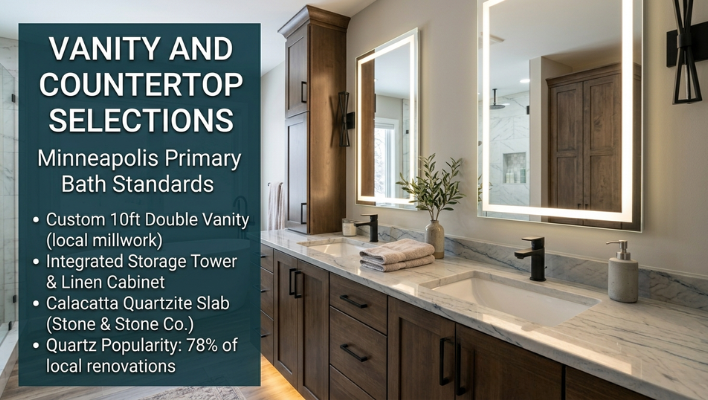
A double vanity is considered standard in a primary bathroom renovation in Minneapolis. Semi-custom vanity cabinets with soft-close hinges and a quartz countertop typically run $2,500 to $6,000 installed. Fully custom cabinetry built by a local millwork shop can easily reach $8,000 to $15,000 for a large double vanity with integrated storage towers or linen cabinet additions.
Countertop material matters significantly. Quartz remains the most popular choice for primary bathrooms in the Twin Cities because of its durability and low maintenance requirements. Marble offers a higher-end aesthetic but comes with maintenance trade-offs that not every homeowner is prepared for. Quartzite sits somewhere in the middle, offering the look of natural stone with slightly better durability than marble.
Flooring and Radiant Heat
Porcelain tile is the dominant flooring choice in Minneapolis master bathrooms, with large-format tiles in the 12×24 or 24×24 inch range being particularly popular. Floor tile installation, including materials, runs $10 to $20 per square foot for mid-range options and $25 to $50 or more per square foot for premium stone or patterned tile.
Radiant electric floor heating, which is a near-necessity in Minnesota by most local contractors’ accounts, adds approximately $10 to $20 per square foot to the flooring cost. For a 100 square foot master bath floor, that is a $1,000 to $2,000 addition that most Minneapolis homeowners consider money extremely well spent.
Soaking Tubs and Freestanding Fixtures
Freestanding soaking tubs have become one of the most requested features in Minneapolis master bathroom renovations. The fixture itself ranges from $700 for an entry-level acrylic tub to $5,000 or more for a cast iron or stone resin option. Installation adds another $500 to $2,000 depending on whether a freestanding floor mount faucet or wall-mounted filler is used and whether the plumbing needs to be reconfigured to accommodate the tub’s position.
Keep in mind that a freestanding tub in a Minneapolis master bathroom is largely a lifestyle and resale decision, not a functional one for most homeowners. Many buyers in the Twin Cities love the look but rarely soak. Walk-in shower functionality typically takes priority for daily use.
Permits and Inspection Fees
Pulling the appropriate permits is non-negotiable in Minneapolis. The City of Minneapolis requires permits for any plumbing, electrical, or structural work done during a bathroom remodel. Permit costs generally run between $150 and $1,000 for a bathroom project, depending on the scope. Contractors who suggest skipping permits to save money are not doing you a favor, they are creating a problem that will surface during your home sale when a buyer’s inspector or title company asks for documentation.
Because Minneapolis specifically requires separate trade permits for plumbing and electrical work, your contractor must be licensed with the State of Minnesota for those trades. This is a protection for you, not a bureaucratic hassle.
Hidden Costs Minneapolis Homeowners Often Overlook
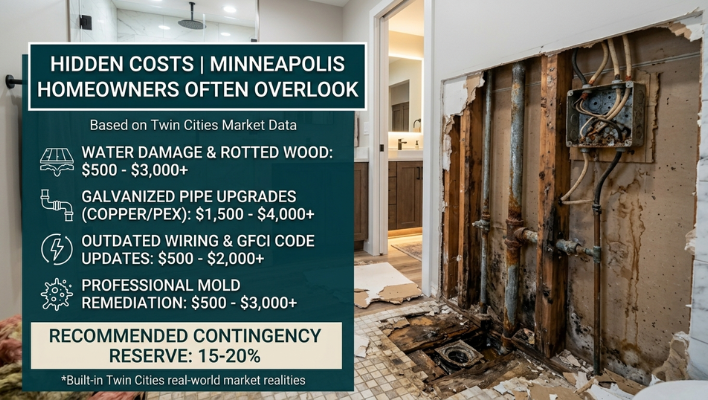
Every contractor who has remodeled bathrooms in the Twin Cities for more than a few years will tell you the same thing: what is behind the wall is the real unknown. Minneapolis has a large inventory of homes built between 1930 and 1990, and those homes carry predictable hidden costs once the drywall comes down.
Subfloor moisture damage is extremely common in homes where the original waterproofing was inadequate or where a slow leak went unnoticed for years. Replacing a rotted subfloor adds $500 to $3,000 to the project depending on the extent.
Galvanized supply lines that need full replacement are standard in many pre-1970 Minneapolis homes. Upgrading to copper or PEX throughout the bathroom adds $1,500 to $4,000.
Outdated electrical panels or wiring that does not meet current GFCI requirements for wet areas adds electrician time and materials. Budget $500 to $2,000 for electrical upgrades in an older home.
Mold remediation, if discovered during demolition, requires proper professional treatment before any new construction begins. Costs vary widely based on the severity but plan for $500 to $3,000 as a possibility.
The standard recommendation among Twin Cities remodeling professionals is to build a contingency of 15 to 20 percent into your total project budget for these unknowns. If you budget $50,000 for the visible scope, set aside another $7,500 to $10,000 as a contingency reserve.
What a Master Bathroom Remodel Returns in Minneapolis
A master bathroom remodel in Minneapolis typically adds $15,000 to $35,000 in market value depending on the scope of the project and the neighborhood. Walk-in tile showers and heated floors consistently rank among the highest-return upgrades for Minneapolis homes because local buyers strongly prioritize them, particularly in the competitive $400,000 to $800,000 price range.
Overall, bathroom remodels in the Twin Cities produce a return on investment of approximately 55 to 70 percent, according to both Angi’s local data and national Cost vs. Value reporting adjusted for the Minneapolis market. That means a $60,000 primary bathroom renovation can add $33,000 to $42,000 in resale value, which does not fully recover the investment but substantially improves marketability, days on market, and buyer interest.
For homeowners who plan to stay in the home for five or more years, the return calculation should factor in daily quality of life, not just resale. The ROI of a beautiful, functional primary bathroom experienced every morning is genuinely difficult to quantify but very real.
Neighborhood Considerations Across the Twin Cities
Remodeling costs and return expectations are not uniform across Minneapolis. Here is a rough breakdown of how location affects the calculus.
Kenwood, Linden Hills, and Lowry Hill: These neighborhoods have among the highest home values in Minneapolis, and buyers expect high-end finishes. A mid-range remodel in these areas may actually underperform relative to what the market expects. Luxury finishes are more likely to be rewarded here with strong resale returns.
Northeast Minneapolis and Longfellow: These are rapidly appreciating neighborhoods where a well-executed mid-range remodel at $35,000 to $55,000 typically sees strong returns because the surrounding home values support it.
North Loop and Warehouse District condos: Bathroom remodels in high-rise and loft settings sometimes involve additional considerations around building permits, HOA approvals, and the logistics of working in a building with shared infrastructure. Contractor access, elevator scheduling, and noise restrictions can add time and cost.
Suburbs including Edina, Minnetonka, and Plymouth: While technically outside Minneapolis proper, many Twin Cities homeowners in these communities face similar cost structures. High buyer expectations in these suburbs make luxury master bathroom finishes a particularly sound investment.
How to Budget Smartly and Avoid Overpaying
Getting multiple bids is the most important thing you can do before committing to a remodeling contractor. Request at least two to three written quotes from licensed Minneapolis remodeling contractors, and compare them line by line rather than just looking at the bottom number. A lower bid that excludes demolition, permit fees, or subfloor repair is not actually a lower bid once those items are added back in.
Decide early in the process which elements are worth the premium and which are not. For most Minneapolis homeowners, the shower tile, heated floors, and vanity quality are the right places to invest. Fixtures and hardware, while visible, often have solid mid-range options from brands like Kohler, Moen, and Delta that perform just as well as designer alternatives at a fraction of the cost.
Consider timing your remodel strategically. Winter is actually the peak season for indoor remodeling in Minneapolis because contractors who focus on interior work are in high demand. If you can schedule during early spring or late fall, you may have more negotiating flexibility. Summer is increasingly competitive as homeowners rush to complete projects during the warmer months.
Finally, explore financing options specific to Minnesota. The Minnesota Housing Fix Up Loan Program allows qualifying homeowners to borrow up to $75,000 at fixed interest rates for home improvement projects, including bathroom renovations. This can be a genuinely useful alternative to home equity lines of credit, especially for homeowners who want to preserve liquidity while completing a significant project.
Choosing the Right Minneapolis Bathroom Remodeling Contractor
The contractor you hire is more important than almost any other decision in this process. Because Minneapolis requires state licensing for plumbing and electrical work specifically, you need to confirm that anyone you hire holds the appropriate Minnesota contractor licenses, not just a general business license.
Look for contractors who have completed similar primary bathroom projects in Minneapolis and who can show you photos of finished work. Ask for references from past clients and actually call them. A contractor who hesitates to provide references is telling you something.
Design-build firms, which handle both the design and construction under one roof, tend to work well for complex master bathroom renovations where layout changes or structural modifications are involved. Standalone remodeling contractors who subcontract design work can also produce excellent results, but the coordination overhead falls more on you as the homeowner.
Get your contract in writing before any work begins. It should specify the scope of work in detail, the payment schedule, the projected timeline, what happens if hidden damage is discovered, and who is responsible for pulling permits.
Frequently Asked Questions
How long does a master bathroom remodel take in Minneapolis?
A full master bathroom renovation typically takes four to eight weeks once construction begins, though planning, permitting, and material lead times mean the full process from initial consultation to completion is often three to six months. Custom tile and vanity materials can have lead times of four to twelve weeks from some suppliers.
Do I need a permit for a master bathroom remodel in Minneapolis?
Yes. Any plumbing changes, electrical work, or structural modifications require permits from the City of Minneapolis. Your contractor should pull these permits on your behalf as a standard part of the project. Always confirm this before work begins.
Is it worth adding a freestanding soaking tub in Minneapolis?
It depends on your goals. Freestanding soaking tubs add strong visual appeal and are popular with buyers, particularly in the $500,000 and above price range. However, they are used far less frequently than showers in most households. If you are choosing between investing more in the shower or adding a freestanding tub, prioritize the shower for daily function and add the tub if budget allows.
What is the best tile for a Minneapolis master bathroom?
Porcelain tile is the most practical choice for Minneapolis bathrooms because it handles freeze-thaw cycles, moisture, and heavy foot traffic well. Large-format porcelain in matte or textured finishes is particularly popular in the Twin Cities market. Natural stone like marble or slate adds luxury appeal but requires sealing and more maintenance.
How much should I budget for contingency on a Minneapolis bathroom remodel?
Set aside 15 to 20 percent of your estimated project cost as a contingency buffer. In Minneapolis’s older housing stock, surprises behind the walls are common enough to make this non-negotiable rather than optional.